Jul 17, 2026
As electric vehicles continue to dominate global automotive markets, body shops are facing a new challenge: EV paint colors are becoming significantly more difficult to repair and match.
Unlike traditional solid colors, many modern EV finishes feature:
Ultra-fine metallic particles
Multi-layer pearl effects
Transparent tinted coatings
Color-shifting pigments
High-flop visual effects under different lighting angles
For automotive refinishing professionals, achieving a perfect color match on modern EVs now requires more advanced color databases, spectrophotometers, and intelligent mixing systems than ever before.
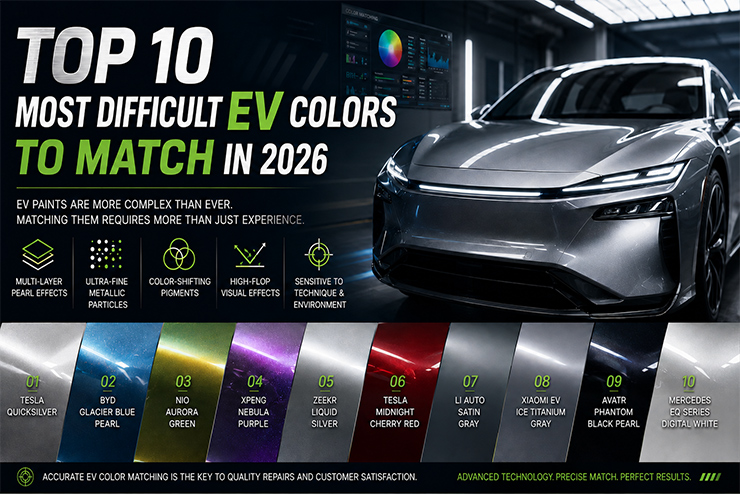
Here are the Top 10 most difficult EV colors to match in 2026.
1. Tesla Quicksilver
Tesla’s Quicksilver remains one of the most challenging colors in the industry.
Why It’s Difficult:
Extremely fine aluminum metallic particles
Strong brightness variation under lighting
Sensitive spray pressure and application technique
High flop effect from different viewing angles
Even slight differences in spray gun distance or atomization can noticeably change the final appearance.
2. BYD Glacier Blue Pearl
BYD has rapidly expanded globally, and Glacier Blue Pearl has become a common repair challenge for body shops.
Why It’s Difficult:
Multi-layer pearl structure
Transparent blue tint effect
Color shifts heavily between sunlight and indoor lighting
Difficult blend transitions
Many traditional paint databases still lack stable formula coverage for newer BYD colors.
3. NIO Aurora Green
NIO’s premium EV finishes are designed with luxury-level visual depth.
Why It’s Difficult:
High chromatic pearl pigments
Green-to-gold color movement
Strong sensitivity to film thickness
Requires extremely controlled blending technique
This color often appears different depending on viewing distance and weather conditions.
4. XPENG Nebula Purple
Nebula Purple is one of the most visually dynamic EV colors released in recent years.
Why It’s Difficult:
Multi-angle color-changing effect
Violet and blue interference pearls
Difficult orientation control of metallic particles
Easy to create patchiness during repair
Without accurate formula data and spray-out verification, repairs can become highly inconsistent.
5. Zeekr Liquid Silver
Silver has always been difficult in automotive refinishing, but Zeekr’s Liquid Silver takes complexity to another level.
Why It’s Difficult:
Ultra-bright metallic reflection
Highly uniform particle arrangement required
Strong sensitivity to reducer speed and air pressure
Visible mismatch even with slight metallic orientation changes
This color is especially difficult on large side panels and doors.
6. Tesla Midnight Cherry Red
Tesla’s Midnight Cherry Red combines deep candy-style transparency with layered metallic effects.
Why It’s Difficult:
Semi-transparent red layer
Strong depth perception effect
Requires precise layer control
Difficult to reproduce factory richness
Repairing this finish often requires advanced blending skills and accurate spray-out cards.
7. Li Auto Satin Gray
Matte and satin EV finishes continue growing in popularity.
Why It’s Difficult:
Surface texture affects final appearance
Gloss level consistency is critical
Spot repairs are extremely difficult
Small blending errors become highly visible
Unlike gloss finishes, matte repairs cannot rely on polishing to correct defects.
8. Xiaomi EV Ice Titanium Gray
As Xiaomi enters the EV market, its modern technology-inspired colors are gaining attention.
Why It’s Difficult:
Fine titanium metallic particles
Strong cool-tone reflection
Highly angle-sensitive brightness
Demands accurate spectrophotometer readings
This color can appear completely different under LED lighting versus natural daylight.
9. Avatr Phantom Black Pearl
Black colors may appear simple, but modern pearl blacks are among the hardest finishes to repair perfectly.
Why It’s Difficult:
Hidden blue and purple pearl layers
Extremely sensitive to texture differences
Clearcoat thickness strongly affects appearance
Difficult to maintain consistent gloss depth
Even minor sanding or blending variations become visible under sunlight.
10. Mercedes EQ Series Digital White
Luxury EV brands are introducing highly refined whites with hidden pearl structures.
Why It’s Difficult:
Multiple pearl particle sizes
Extremely clean color requirement
Sensitive to contamination and toner imbalance
Difficult coverage consistency
White colors are unforgiving — even small formula inaccuracies can create visible panel differences.
Why EV Colors Are Becoming Harder to Match
Modern EV manufacturers are using advanced color technologies to create stronger visual identity and futuristic appearance.
Compared with traditional automotive colors, EV finishes now feature:
More complex pigments
More pearl layers
Stronger flop effects
More transparent color structures
Faster color updates between model years
As a result, traditional refinishing systems are struggling to keep up.
How Professional Body Shops Improve EV Color Matching
To successfully repair modern EV finishes, body shops increasingly rely on:
AI-assisted color matching systems
Spectrophotometers
Large global color formula databases
Continuous EV color updates
Spray-out card verification
Advanced blending techniques
The ability to accurately repair EV colors is quickly becoming a major competitive advantage for body shops worldwide.
The Future of Automotive Color Matching
As EV design continues evolving, automotive paint technology will become even more sophisticated.
Body shops that invest in modern color matching solutions today will be better prepared for:
New EV color trends
Faster repair cycles
Reduced rework
Higher customer satisfaction
In 2026 and beyond, accurate EV color matching is no longer optional — it is essential for profitable automotive refinishing operations.
ЧИТАТЬ ДАЛЕЕ



 Поддерживается сеть IPv6



 中文
中文